For internationally qualified nurses planning to work in New Zealand, understanding the registration process is an important first step. The Nursing Council of New Zealand (NCNZ) assesses internationally qualified nurses to determine whether they meet the requirements to practice safely in New Zealand.
Depending on their qualifications and nursing experience, some applicants may be required to complete a theory examination and a clinical competence assessment (OSCE).
This guide explains the Nursing Council of New Zealand examination for registered nurses, including eligibility, the theory exam, OSCE, English requirements, fees and the registration process.
What Is the Nursing Council of New Zealand Examination for Registered Nurses?
The Nursing Council of New Zealand may require some internationally qualified nurses to complete a competence assessment before registration. This assessment can include an online theoretical examination and a clinical competence assessment called the OSCE. The Council determines whether an applicant needs these assessments based on their individual qualifications, registration and experience.
Who Needs to Take the NCNZ Examination?
Internationally qualified nurses should first complete the Nursing Council’s self assessment to understand their likely registration pathway.
Applicants may need to complete a competence assessment if the Council determines that further evidence of their nursing knowledge and clinical competence is required.
Internationally qualified nurses must provide evidence of at least 1,800 hours of post-registration nursing practice. The exact pathway depends on the nurse’s qualification, current registration and country of education or practice.
Therefore, nurses should check their individual eligibility rather than assuming that every overseas nurse needs to take the same examination.
What Is the NCNZ Theory Examination?
The Nursing Council of New Zealand’s IQN theoretical examination for registered nurses is an online multiple choice examination designed to assess nursing knowledge at the level expected of a registered nurse in New Zealand.
For registered nurses, the theoretical test consists of 120 multiple choice questions that must be finished within 165 minutes. It is split into Part A, which emphasizes medication safety, and Part B, which evaluates more general nursing knowledge.
Part A : Medication Safety : 12 questions / 30 minutes
This part tests how well candidates understand the safe use of medicines and the precautions involved in medication administration.
Part B: Nursing Knowledge: 108 questions / 135 minutes
This section covers broader nursing knowledge and areas required for safe nursing practice.
A separate 15 minute period is provided before the examination to read the instructions and complete a software tutorial.
The examination can be taken at approved Pearson VUE test centers in New Zealand and overseas. Candidates have up to three attempts to complete the examination successfully. If only one part is unsuccessful, the candidate can retake that part.
Preparation should cover medication safety, medicine calculations, nursing care, clinical decision making, professional responsibilities and safe nursing practice.
What Is the NCNZ OSCE?
The OSCE assesses the ability of nurses to exhibit their clinical skills and utilize nursing knowledge in real life scenarios.
Candidates complete a two day orientation and preparation course followed by the OSCE in Christchurch, New Zealand.
For registered nurses, the OSCE consists of 10 stations, with 12 minutes allocated to each station.
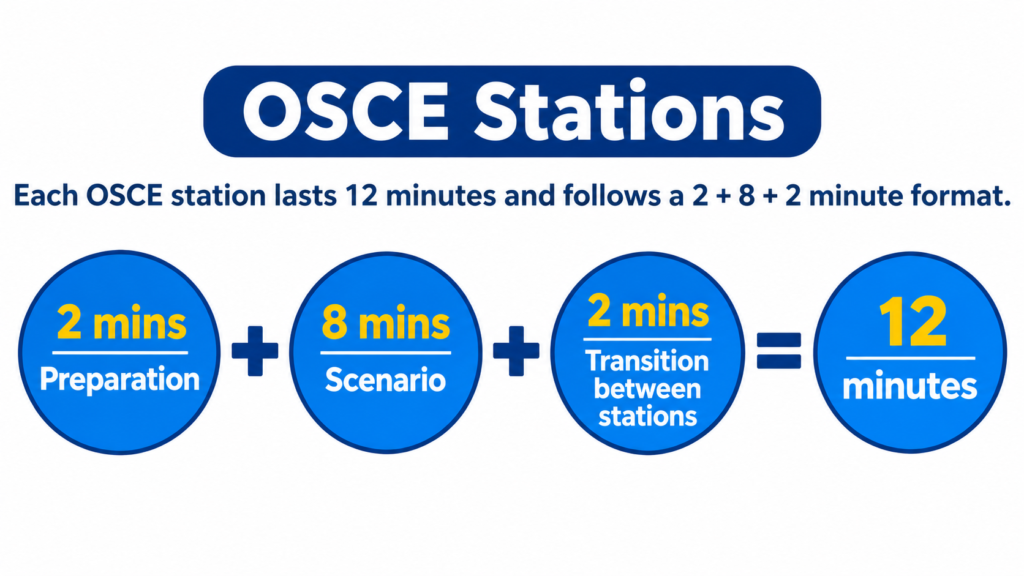
The OSCE evaluates how nurses apply their knowledge and skills in clinical situations. It can assess areas such as
- Patient assessment
- Clinical decision making
- Communication
- Medication administration
- Infection prevention and control
- Documentation
- Patient safety
- Cultural safety
- Professional and ethical practice
Nurses preparing for the OSCE should practice clinical scenarios, communication and safe decision making rather than relying only on theoretical study.
What Are the English Language Requirements?
English language competence is one of the requirements for New Zealand nursing registration.
The Nursing Council currently accepts IELTS Academic and OET through its test based pathway.
For IELTS Academic, the current minimum scores are:
- Reading : 7
- Listening : 7
- Speaking : 7
- Writing : 6.5
For OET, the current minimum scores are:
- Reading : 350
- Listening : 350
- Speaking : 350
- Writing : 300
The Council also has alternative pathways for some internationally qualified nurses, depending on their education and registration history. Applicants should check which English language pathway applies to them before taking a test.
How Much Does the NCNZ Competence Assessment Cost?
The current published Nursing Council fees include:
| Assessment | Fee |
| Theory examination : Part A and B | NZD $140 |
| Theory re sit : Part A | NZD $32 |
| Theory re sit : Part B | NZD $108 |
| Orientation and preparation course | NZD $500 |
| OSCE | NZD $3,000 |
These are assessment related fees. The Nursing Council also charges an application and processing fee of NZD $485 for internationally qualified nurse registration. Other costs, such as document verification, translations, travel and accommodation, may also apply, because the OSCE is held in Christchurch.
Fees can change, so applicants should check the latest NCNZ fee information before making financial plans.
How Do International Nurses Apply for New Zealand Registration?
The registration process involves checking your eligibility, verifying your documents and completing the requirements set by NCNZ.
Applicants may then need to
- Verify your documents through TruMerit.
- Provide evidence of nursing experience.
- Meet the English language requirement through an accepted pathway.
- Complete the Welcome to Aotearoa New Zealand programme.
- Complete the theory examination if directed to do so.
- Complete the OSCE if required.
- Meet the remaining registration requirements.
The exact process can differ between applicants. This is why checking the current Nursing Council requirements before starting the application is important.
Is NCLEX Required for New Zealand Nursing Registration?
The NCNZ theoretical examination is different from the NCLEX-RN. Nurses should not assume that passing NCLEX-RN automatically replaces the competence assessment required by the Nursing Council. The registration pathway is determined by NCNZ based on the applicant’s individual qualifications, registration and experience.
How Can Nurses Prepare for the NCNZ Examination?
For the theory exam, practice multiple choice questions and review medication safety, calculations, clinical reasoning and nursing care.
For the OSCE, practice timed clinical scenarios and focus on communication, assessment, documentation and safe decision making.
It is also useful to become familiar with New Zealand’s expectations around professional practice and cultural safety.
Final Thoughts
The New Zealand nursing registration examination process helps assess whether internationally qualified nurses meet the required standards of nursing knowledge and clinical practice. Depending on their individual pathway, applicants may need to complete a theory test and an OSCE.
Nurses planning to work in New Zealand should first confirm their eligibility, understand their individual pathway and prepare the required documents. Checking the latest NCNZ requirements is essential because fees and registration requirements may change.
Planning to apply for New Zealand nursing registration? Flyworld can help internationally qualified nurses understand the registration pathway, required documents and next steps based on their individual profile.